



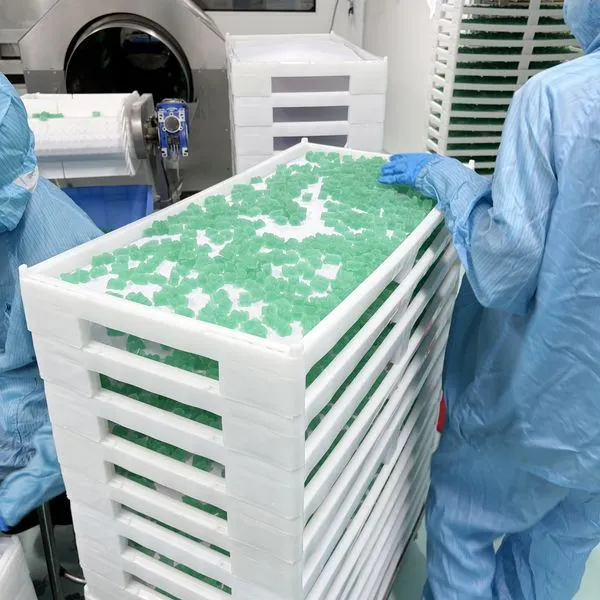
When people picture gummy manufacturing, they often focus on mixing, depositing and mould shape. One of the less visible stages happens after the pieces are formed. Gummies may need time under controlled conditions to develop their intended moisture balance, texture and surface before coating and packaging. This stage is often called drying, curing or conditioning. The exact language and process differ by formula and equipment, but the basic principle is the same: a newly formed gummy is not automatically ready to be counted into a bottle.
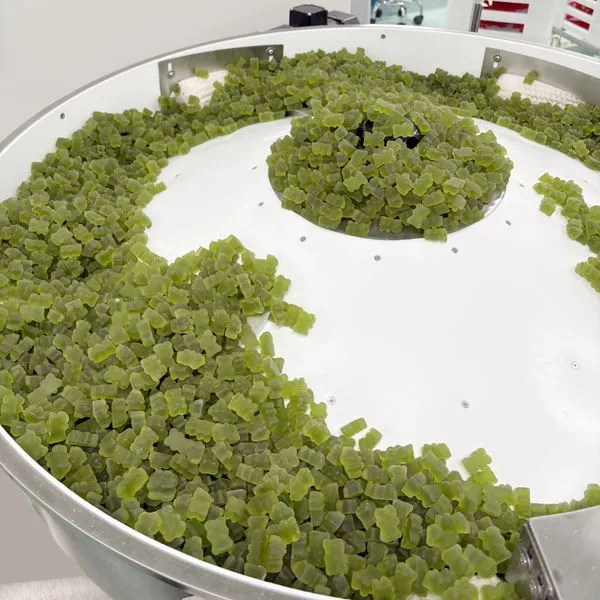
Cooling and conditioning are not the same thing
Cooling helps the gel structure set enough for handling or demoulding. Conditioning continues the process by allowing moisture and texture to move toward a defined target. A piece can feel firm on the outside while remaining softer inside. Packaging too early may trap a product at an unstable moisture condition. Waiting too long or using unsuitable air conditions can make the surface hard while the center remains different. The manufacturer therefore needs measurable release criteria rather than relying only on elapsed time. Time is a process input; the finished condition is the result that matters.
Moisture content and water activity answer different questions
Moisture content describes how much water is present. Water activity relates to how available that water is within the product. Two gummies with similar total moisture can behave differently because sugars, fibers, salts and gelling ingredients bind water in different ways. Water activity can influence texture changes, sticking and microbiological considerations, but it should not be treated as a single universal pass number for every gummy. The formula, process, packaging and intended shelf life must be evaluated together. Brands do not need to become laboratory specialists, but they should ask how packaging readiness is defined and whether the target is supported by appropriate product development and stability work.
Formula composition changes conditioning behavior
Pectin and gelatin systems do not necessarily condition in the same way. Sugar-free systems, high-fiber formulas and gummies with substantial mineral or amino acid loads can also behave differently. Important variables include:
- gelling system and solids level;
- types of sugars, syrups or alternative sweeteners;
- acid addition and final pH;
- active ingredient load;
- piece weight and surface area;
- coating system;
- temperature and relative humidity;
- airflow and tray loading.
This is why copying a drying time from another product can be misleading. The process should be established for the actual formula and piece.
Piece size and shape affect the moisture path
A small bear, a thick cube and a thin disc have different surface-area-to-volume relationships. A thick center may take longer to reach the desired condition. Deep details or narrow edges may dry unevenly or become fragile. Custom mould discussions should therefore include more than appearance. The technical team needs to consider piece weight, thickness, demoulding and how the shape behaves during conditioning and coating. If the same formula is moved into a substantially different mould, process assumptions may need to be reviewed again.
Room conditions need control
Warm, humid air may slow moisture removal or encourage sticky surfaces. Air that is too dry can create a tough outer layer or excessive weight loss. Airflow also matters: tightly loaded trays and uneven circulation can create differences across a batch. Commercial conditioning areas use monitored environmental conditions and defined handling practices. Operators may rotate or sample trays, record time and conditions, and check pieces from different positions. The goal is not simply to make the gummies “dry.” It is to bring the batch into a controlled range while preserving the intended chew.
Coating depends on surface readiness
Oil, wax, sugar or acid-sugar coatings behave differently on a warm or moist surface. Applied too early, a coating may become patchy, dissolve or migrate. Applied after excessive drying, it may fail to adhere evenly. Coating also changes the consumer experience and can influence how pieces move through counting and filling equipment. A sticky product may bridge in a hopper or cling to neighboring gummies. Excess surface oil can mark labels or packaging components. The coating step should therefore have its own specifications, including application amount, coverage and appearance.
Weight changes must be understood
As gummies lose moisture, piece weight changes. This matters for yield, net quantity, count and the amount of active ingredient represented by a finished piece. Formulation and production teams need a clear reference point for calculations: deposited weight, conditioned piece weight and acceptable finished-piece variation are not interchangeable. For a dietary supplement, the label amount is tied to the finished serving. Production records and testing plans should reflect the commercial product, not only the mass at the depositing stage.

Packaging readiness should use defined checks
Before packaging, the batch may be reviewed for:
- appearance and color consistency;
- piece weight and dimensions;
- texture or firmness within an approved range;
- surface tackiness and coating coverage;
- moisture-related measures appropriate to the formula;
- visible damage, deformation or clumping;
- relevant in-process or finished-product specifications.
Not every check needs to be performed with the same frequency, but the release decision should be documented. “It has been two days” is not a complete packaging specification.
Packaging and climate still matter afterward
Conditioning establishes the starting point; packaging must help maintain it. The closure, liner, barrier properties, headspace and any desiccant choice should match the product and destination climate. A gummy shipped through hot and humid regions can experience conditions very different from the production room. Distribution testing and stability work should consider realistic handling rather than only a comfortable indoor environment. Once opened, the container is repeatedly exposed to ambient air. Directions such as keeping the cap closed and storing in a cool, dry place are meaningful only when the package design and formula support the expected use period.
Common warning signs in development
During trials, teams should investigate:
- pieces sticking together soon after coating;
- a hard shell with a soft center;
- visible sweating or syrup migration;
- cracking at edges or detailed mould features;
- inconsistent weight loss across trays;
- major texture change after packaging;
- coating that dissolves, flakes or pools.
These observations do not always point to one cause. Formula, room conditions, time, coating and packaging can interact. Good records make troubleshooting much faster.
Questions brands can ask a manufacturer
Brands can include the following in a technical review:
- How is the target packaging condition defined?
- Which in-process measurements are recorded?
- How are different tray locations sampled?
- Does the proposed mould change conditioning time?
- When is the coating applied and inspected?
- Which package will be used for stability work?
- How are hot or humid distribution conditions considered?
The answers should connect the process with product specifications, not rely only on a standard number of hours.
التعليمات
Is a firmer gummy always a drier gummy?
No. Firmness also depends on the gelling system, solids, acids, active ingredients and storage temperature. Moisture-related measurements and texture should be evaluated together.
Can gummies be packaged immediately after demoulding?
Some processes may be designed for short handling times, but many formulas require controlled conditioning. The correct decision depends on the validated process and finished-product criteria.
Does conditioning establish shelf life?
No. It establishes a controlled starting condition. Shelf life should be supported by stability work on the final formula in the commercial packaging.
The quiet stage that protects the finished experience
Drying and conditioning may not appear on the front label, but they influence whether gummies arrive with the texture, appearance and handling qualities the brand approved. الكنغر الأحمر discusses formula, mould, conditioning, coating and packaging as connected parts of one manufacturing plan. For brand owners and importers, understanding that connection makes sample approval more meaningful and reduces surprises when production moves to commercial scale.