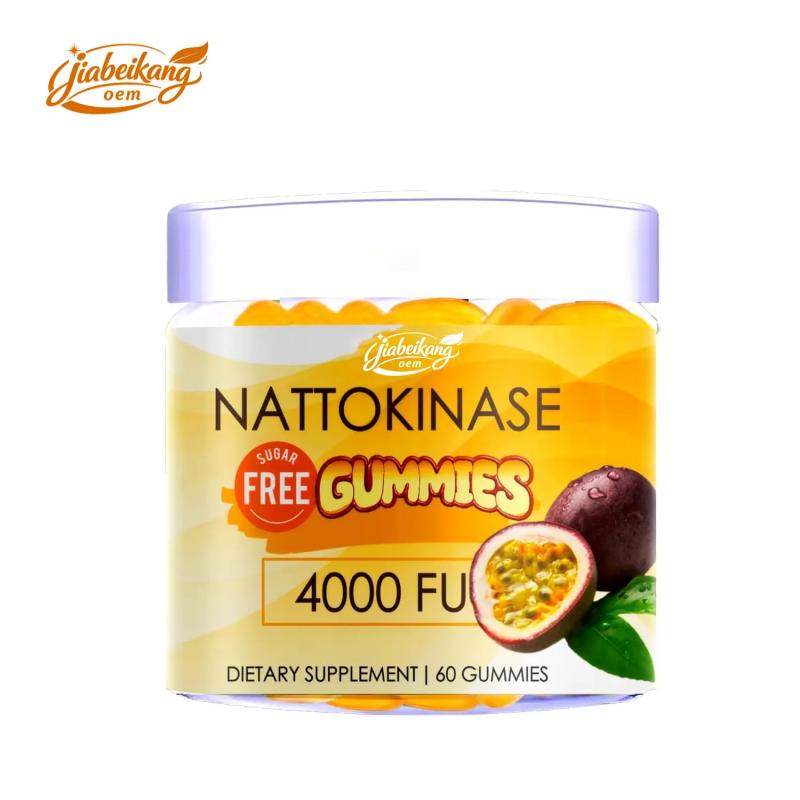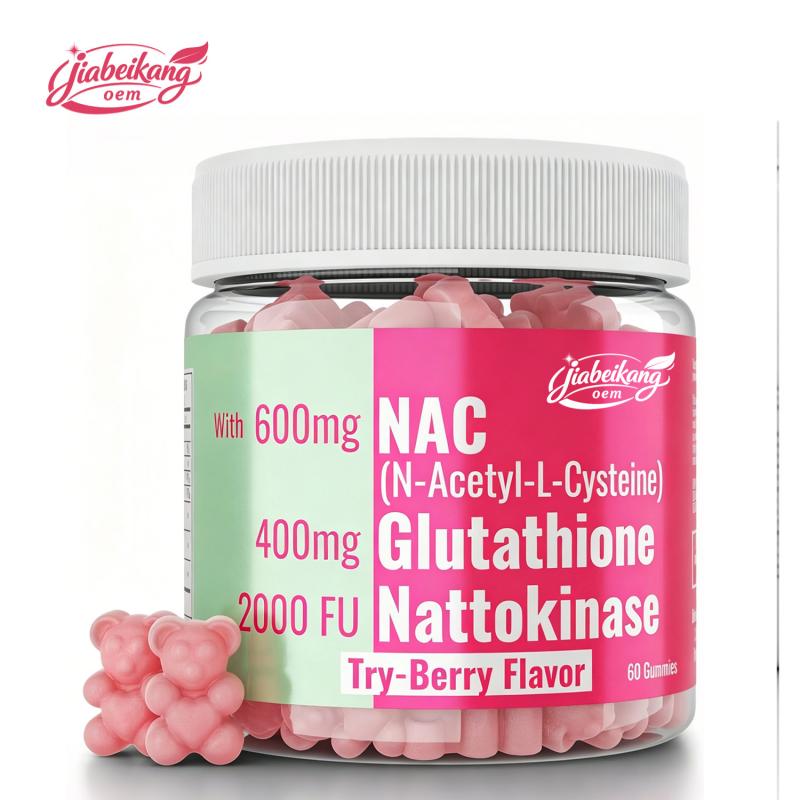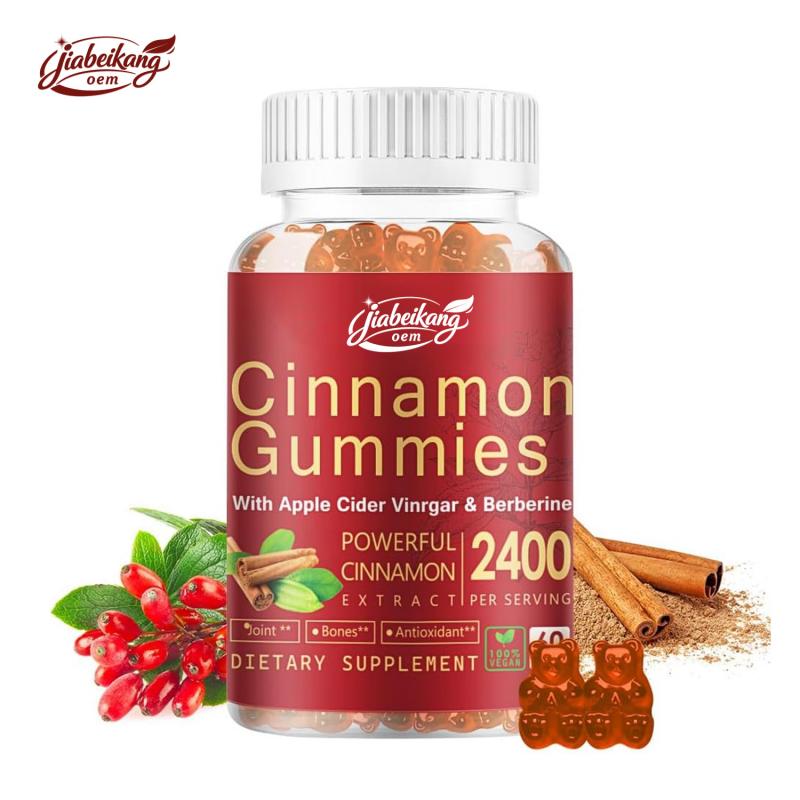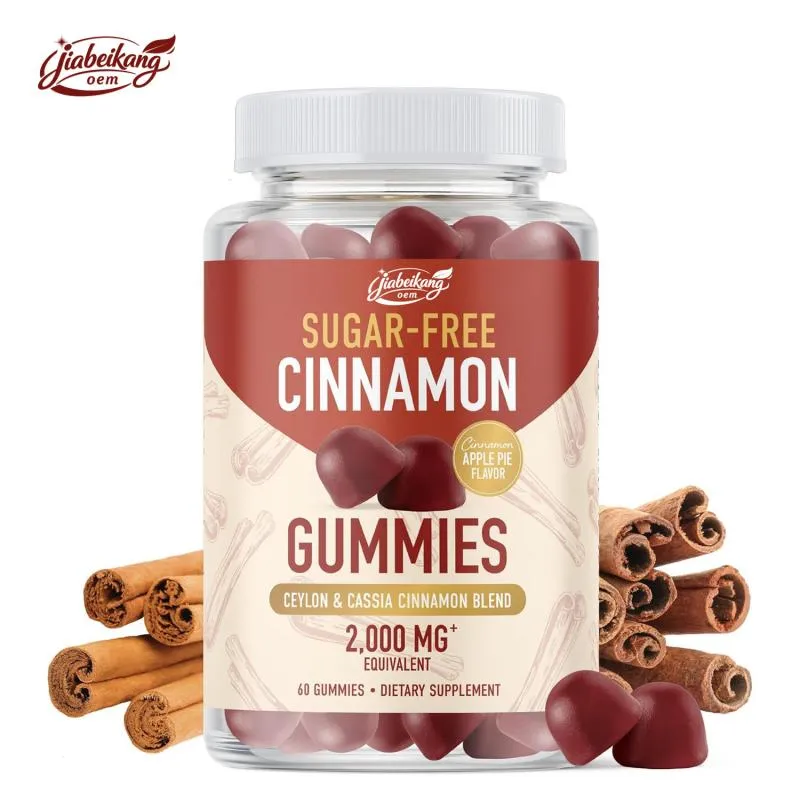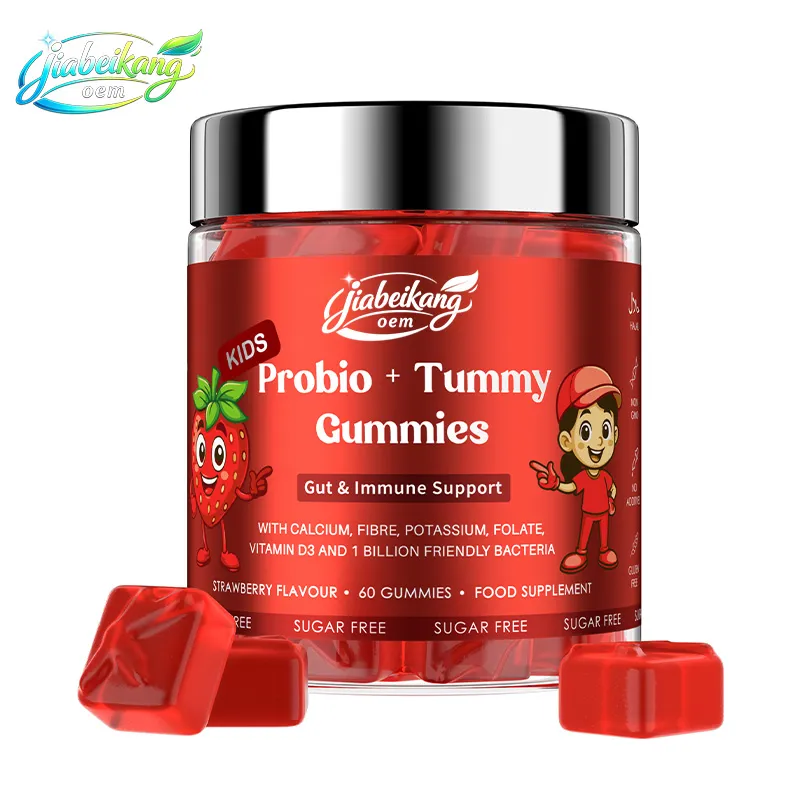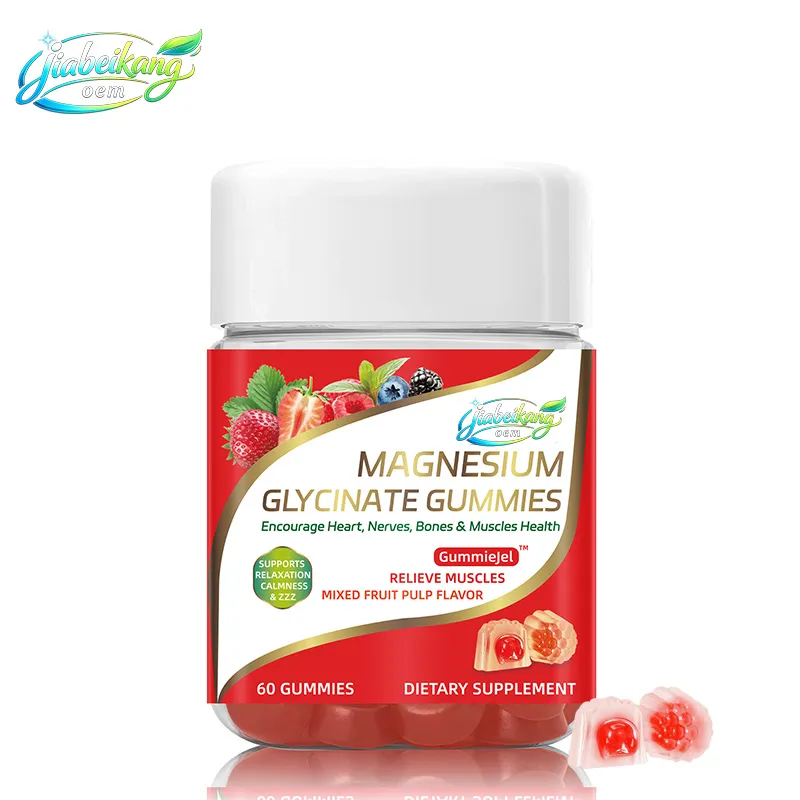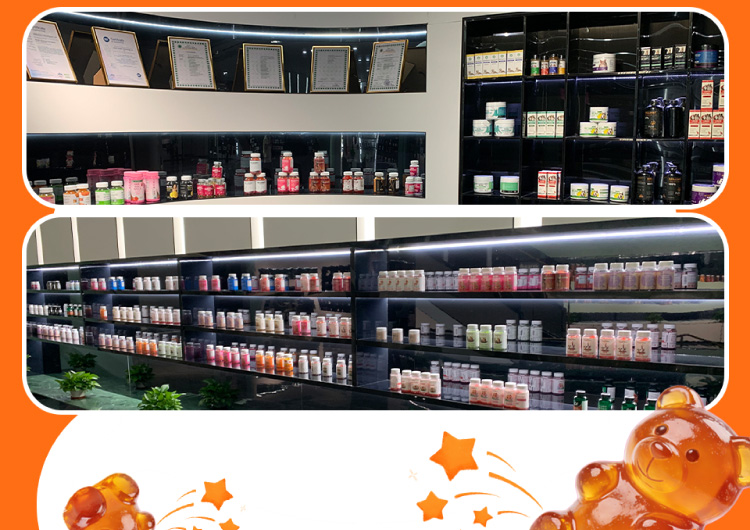




If your launch depends on a gummy that tastes good, carries the right active dose, and arrives in retail-ready packs, the gummy supplement manufacturer decision matters early. Gummy supplement manufacturing for global brands covers formula review through shipping documents.
Settle the active ingredients, serving size, texture, target country, pack format, and order plan before the pilot batch. Review available gummy manufacturing services and product categories.
Why Does Formula Control Your Launch Risk?
Your formula sets more than the nutrition panel. It affects cooking temperature, moisture, taste masking, gummy weight, stability, claims, and the pack. A capsule formula may fail in a gummy because heat and water activity change the production window.
Gummy Formula Development for Your Market
Give the R&D team your target market, active ingredients, dose per serving, claims, dietary requirements, and preferred texture. A finished formula can be reproduced to your specification. Without one, a custom gummy formula and packaging can be built around local ingredient rules and dosage limits.
Common routes include custom gummy supplements for vitamin, collagen, melatonin, biotin, botanical, protein, and antioxidant concepts.
Choose the Gummy Base before You Choose the Flavor
Gelatin gives a firm, elastic chew. Pectin gives a cleaner bite and suits many vegan concepts. Filled gummies can hold actives sensitive to heat or pH. A double-layer or taste-masked format can help when minerals or botanicals taste sharp. Check first bite, aftertaste, and stored texture, not just the sample day.
What Happens from Formula to Finished Gummy?
Gummy manufacturing from formula to finished product should produce a repeatable batch. Small changes in solids, drying time, or coating can show up as sticky pieces, weight variation, or a short shelf life.
OEM Gummy Manufacturing Flow in Practice
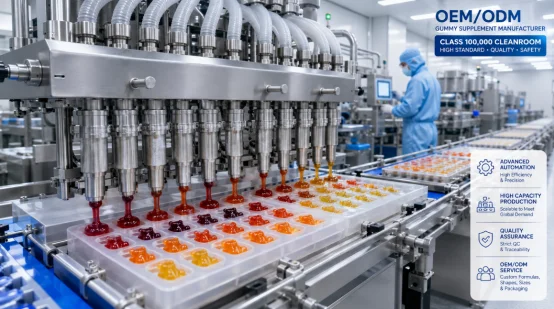
- Raw materials are qualified and each incoming batch receives IQC checks for heavy metals, microbes, and pesticide residues.
- Ingredients are weighed with a dual-verification step, then mixed and cooked. Documented critical control points track the key stages.
- The gummy mass is deposited into custom molds, cooled, demolded, dried, and coated. Shapes include bears, fruit, hearts, rounds, and squares.
- Finished pieces are counted or weighed into bottles, jars, pouches, or other approved packs. Sealing, coding, labeling, and carton packing complete the batch.
| Production Parameter | Capability / Option |
| Sample development | Within 7 days |
| Dedicated gummy lines | 4 lines |
| Daily gummy output | Up to 6 million pieces |
| Common gummy unit weight | About 3 g, with 3.5 g and 4 g options |
| Gummy bases | Pectin, gelatin, filled, liquid-filled |
| Shape options | Bear, koala, heart, cube, square, fruit, petal |
| Packaging formats | Bottle, jar, pouch, blister, retail carton |
How Do You Keep Each Batch Consistent?
Buyers usually worry about active content, microbiological safety, and what happens after the product leaves the plant. A clear quality plan gives you records for release, retailer review, and customer questions.
Gummy Quality Control That Supports Release
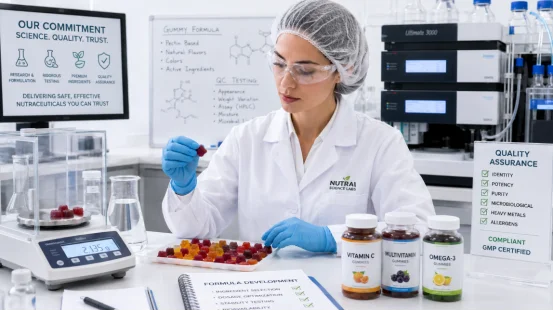
Raw material suppliers are audited before approval. Each delivery is checked, active ingredients are verified, and batch records support traceability. During production, teams monitor temperature and humidity, sanitation, filling quantity, sealing performance, and foreign matter. Laboratory work can include heavy metals, active content, ingredient identity, microbiology, physical properties, and simulated stability.
Moisture-proof and light-shielding materials are selected through compatibility checks. Storage and transport conditions are monitored, with special handling for cold-chain formulas. A Certificate of Analysis, production records, and stability data give your team usable release evidence.
Which Packaging and Compliance Details Should You Lock in?
Packaging supports sales, product protection, and market access. Confirm gummy packaging, pack size, serving count, closure, liner, desiccant, label area, barcode, and shipping carton before artwork. Global supplement compliance starts here. A beautiful label that misses a required statement can hold up a launch.
Build the Label around the Destination Market
International gummy supplement labeling varies. In the United States, the name normally identifies a dietary supplement, with Supplement Facts, serving details, ingredient order, allergen wording, directions, and the FDA disclaimer. European labels use food supplement, metric units, reference intake information, allergen disclosure, best-before details, and caution language. Southeast Asian markets may add local language, registration numbers, health-food wording, or specific warnings.
| Market Check | Artwork Checks |
| United States | Dietary supplement name, Supplement Facts, serving details, allergens, disclaimer |
| European Union and United Kingdom | Food supplement name, metric units, reference intake, allergens, best-before and storage text |
| Malaysia and Indonesia | Local language rules, metric content, active-ingredient details, registration or filing data |
| Thailand and Vietnam | Health-food wording, warning text, local-language supplement label, product origin |
Keep the Quote Comparable
Ask every supplier to price the same assumptions, including active dose, gummy weight, flavor, coating, mold, bottle count, label finish, testing, carton size, Incoterm, and destination. Flexible MOQ can help a new brand test demand, while a fixed schedule supports inventory planning. Samples often move by express. Bulk orders usually move by sea, with timing set by route and customs model.
What Can a Global Gummy Supplement Manufacturer Handle?
The useful supplier keeps formulation, compliance, production, packaging, and export paperwork connected. Fewer handoffs make changes easier to track.
A Soft-Gummy Partner with In-House Control
Canguro rosso combines formula development, regulatory review, gummy production, packaging support, and export documents in one chain. Published capabilities include a 100,000-level purification workshop and laboratory, more than 4,000 square meters of controlled space, four gummy lines, and output up to 6 million pieces per day.
The team reports 7-day samples, in-house tests for heavy metals, active ingredients, microbes, and identity, plus full-batch COA and production records. Pectin, gelatin, filled, and liquid-filled formats leave room to adjust a product when a market, claim, or flavor changes. That suits brands seeking a custom gummy formula and packaging plan without five vendors.
FAQ
Q1: Who Approves Each Stage of a Turnkey Gummy Project?
A: The brand normally approves the product brief, reference sample, claims, artwork, commercial terms, and shipping information. The manufacturer controls production records, in-process checks, finished-batch inspection, and the documents agreed for release. Name each approver before the project starts.
Q2: When Should Packaging Be Locked for Bulk Production?
A: Lock the container, gummy count, closure, liner, label dimensions, artwork version, carton configuration, and coding position before packaging materials are ordered and the bulk schedule is released. A later change should trigger a documented impact review.
Q3: How Should Changes Be Managed after Sample Approval?
A: Record the requested change against the approved formula, sample, and packaging version. Then review its effect on materials, testing, cost, timing, and market compliance. Bulk production should use only the revised version approved by both sides.
Q4: What Should Be Included in the Batch Release Handover?
A: The handover should identify the produced formula and packaging versions, completed inspections, agreed COA or test reports, batch records, shipment documents, and the person who authorized release. Exact contents should match the purchase agreement and destination-market needs.