



The replacement quotation has the right ingredient name. The price works, and purchasing can get it before the next batch.
There is still a technical question to settle: can this particular material be used in the approved gummy formula?
We would put that question into a change request before placing the material into approved stock. Requalification starts with the differences between the current and proposed sources.
It ends with a decision that production can act on, including any conditions and the first permitted use. A certificate attached to the quotation is evidence to review along the way.
Define the ingredient supplier change for the gummy formula
Consider a hypothetical project with an approved powder bought through distributor A. Purchasing now proposes distributor B.
Does B supply the same material from the same manufacturer and site, or a different manufacturer’s powder? The answer changes the assessment.
A new invoice address does not necessarily mean a new ingredient, and a familiar trade name does not establish an unchanged source.
Draw the two routes on the request. Include the material identifiers and the source information available for technical review.
Where confidential information needs a restricted review arrangement, resolve that access question explicitly. Leaving the origin unknown is an unresolved question, even if the proposed delivery date is convenient.
For a discussion through our custom formulation support, send the approved specification with the proposed specification. Identify the sample and certificate belonging to each.
The reason for the change belongs there too: a discontinued source may leave different scheduling options from a cost-saving proposal.
A matching percentage can conceal a different calculation
Suppose both quotations say 20%. In this fictional example, the current powder declares a specified constituent at 20% on an as-received basis. One kilogram therefore supplies 200 g of that constituent.
The proposed powder quotes 20% on a dry basis. We cannot yet put those two percentages into the formula as equivalents.
The technical reviewer needs the moisture information, calculation basis and methods. Even after the units agree, the assays may not describe comparable measurements. Ask what was measured and how.
For a botanical, the relevant identity, plant part and extraction information also belong in the comparison. A mineral review needs the actual form and elemental contribution.
This arithmetic is an illustration of a document mismatch, not a formula recommendation. It does not establish what the finished gummy contains.
It shows why the replacement review needs more than a purchasing spreadsheet headed price per unit of active.
Then turn the specification over, figuratively speaking. What else is in the powder? A carrier or another component may matter to processing, taste or the ingredient statement.
Request the available composition and relevant allergen declarations. The label reviewer may have a question even when the formulator finds the active contribution acceptable.
Build the assessment around differences that matter
Here is a working comparison sheet. Replace its example questions with the ones relevant to the material. It contains no universal acceptance limits.
| Comparison entry | Question for this formula | Record for the decision |
| Manufacturer and site | What source does the approval cover? | Traceable source information |
| Identity and composition | Is this the specified material? | Specifications and declarations |
| Assay basis and method | Can the calculation remain unchanged? | Technical reconciliation |
| Physical characteristics | What could change during handling or incorporation? | Relevant comparison or trial |
| Sensory findings | Does the finished comparison meet the agreed criteria? | Identified samples and review |
| Applicable contaminant criteria | Does the material meet the requirements? | Suitable verification evidence |
Imagine revisiting this sheet after a buyer has left the company. A signature and six ticks would reveal little about the assessment.
The reviewer’s note should identify the evidence that closed each question and the work still outstanding. One row might refer to a compared declaration; another might point to T1 results.
That is enough to make the choices recoverable without rebuilding the email trail.
The approved material can reveal what to ask. If production relies on a specified physical characteristic, bring that requirement into the comparison.
Asking for every property a supplier can measure is expensive and may still miss the feature the actual process depends on.
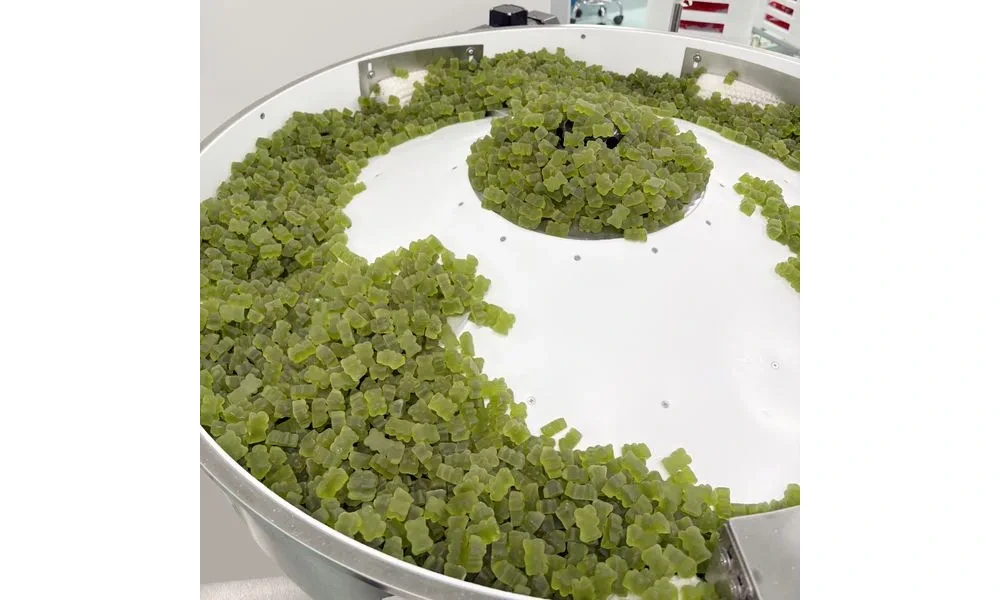
Use a gummy formula requalification trial to test the change
Continue the hypothetical example. The replacement is darker and has a different carrier.
The formulator proposes a small comparison using the approved source beside the proposed source, with other deliberate inputs held steady where practicable.
The point is to see what the substitution changes before trying to compensate for it.
Call that comparison T1. If a flavor adjustment follows, identify it separately as T2. An acceptable T2 sample may be useful, but it represents a source change plus an adjustment.
The report needs both steps to explain what production would have to repeat.
A useful observation might read: visible lumps remained during the recorded addition step in T1 with source B. Attach the material lot and sample identifiers.
That gives the technical team an event to investigate. “B works badly” provides much less help, especially when the reviewer did not attend the trial.
In the T1 example, a photograph belongs with the observed addition step and its sample identity. A later photograph of an attractive finished gummy does not explain whether the lumps dispersed, were removed or remained.
The report should follow the observation to its outcome. That makes the picture evidence for a particular question rather than decoration in the approval file.
Track gummy parameters during formula requalification
The trial should connect the ingredient change to measurable gummy properties. Compare the current and proposed source at the same recorded process stage, conditioning time and measurement temperature. Select the parameters below according to the changed ingredient and the approved formula. Enter the actual baseline, trial result and approved acceptance range for each selected parameter.
| Gummy parameter | What to record | Comparison conditions |
| pH and soluble solids | pH and refractometer reading in °Brix. | Record the sample preparation, temperature and process stage. Compare equivalent samples. |
| Moisture and water activity | Moisture content (%) and water activity (aw). | Record each result separately after the same conditioning period and at the stated measurement temperature. |
| Textuur | Hardness (N) and, where relevant, springiness, chewiness and surface tack. | Use the same instrument settings, sample geometry and sample age, with a sensory comparison to the retained reference. |
| Piece weight and active delivery | Individual gummy mass (g), mass variation and measured active content per gummy or serving (mg). | Record the sampling plan and analytical basis. Reconcile dose with piece weight and the intended serving count. |
| Appearance and processing | Color, visible particles, dispersion, depositing temperature (°C), viscosity and setting or demolding time. | Select the observations affected by the changed source and compare with the approved process record. |
For example, a hypothetical 3.0 g gummy with a measured active concentration of 10 mg/g contains 30 mg per piece. At the same concentration, a 2.7 g piece contains 27 mg. This calculation illustrates why piece weight and measured concentration must be reviewed together when assessing a changed source.
Published gummy formulation studies measure pH, soluble solids, water activity and texture, and show that ingredient changes can alter these properties. Use those findings to select relevant checks. Set this product’s limits through its approved specification and supporting trials, with the qualified reviewer assessing any additional stability work required.
Further reading on gummy measurements and formulation effects
Development of healthier gummy candy by substituting glucose syrup with various fruit juice concentrates. https://pmc.ncbi.nlm.nih.gov/articles/PMC11521684/
Red Beet Extract Powder, Gelatin and Sucrose Interactions in Gummy Candies. https://www.mdpi.com/2304-8158/14/17/3138
Review finished gummy specifications after the supplier change
The next review returns to the finished gummy. Which specification entries could this change affect, and what supports the entries expected to remain unchanged? Record that assessment before commissioning further work.
Any new test needs its purpose, method and acceptance criteria defined in advance.
Stability deserves a specific assessment as well. Give the assessor the source comparison and trial findings, then ask which existing conclusions remain applicable.
The answer may retain part of the file and require additional support elsewhere. Our test- en stabiliteitshandleiding gives context for that discussion.
There may be another decision hidden in the supplier documents. Suppose the current specification names a narrower limit than the alternative offers. Quality cannot close the row merely by approving the supplier.
It has to establish what material requirement purchasing will order against, and whether a proposed requirement change is justified. Put that conclusion on the approved specification or change record.
The receiving team then has a defined requirement for the first delivery.
For US dietary supplement manufacture, the specification and verification provisions in 21 CFR 111.70 and 111.75 are relevant. Apply the applicable requirements to the firm’s activities.
A supplier certificate does not, by itself, settle every verification duty.
Give the label reviewer the changed composition
A technical acceptance can arrive before the market assessment is complete. Send the relevant composition changes to the label reviewer, including carriers, allergen information and statements tied to the old source.
Have the intended destination assessed before implementation.
For an EU project, ingredient status and labeling need review against the applicable EU and national framework. A US assessment is not a decision for every European destination.
When discussing our brand and compliance support, name the countries and the remaining questions. Record the agreed scope of assistance and who authorizes the market decision.
Make the first-use instruction unambiguous
Imagine B is approved for the next defined batch while A remains in the warehouse. Production needs B’s material identity, source, specification revision and conditions of use.
The batch record then captures the actual lot dispensed. A note saying use the new powder becomes ambiguous as soon as another replacement is proposed.
Give the remaining A stock a status too. If both sources stay permitted, preserve which finished batches used which source. That distinction will matter if a later investigation needs to follow a shared input.
Use the discussion of our kwaliteits- en nalevingsaanpak to settle the notification and approval route.
For a source-change review with Rode kangoeroe, bring both specifications, representative certificates and the proposed first-use batches.
The useful outcome is a documented answer for those batches, with any outstanding work visible to purchasing and production.