




Conclusion: A collagen gummy can realistically deliver only the amount that fits the planned piece weight and serving count while preserving chew, flavor, process consistency, and package fit. There is no universal maximum collagen-per-gummy number; the workable payload must be confirmed through the selected collagen specification and prototype.
A collagen gummy can only carry a practical amount of collagen after the full formula is considered. The target on the brief must fit inside the planned gummy weight and serving count while leaving room for the gelling system, sweeteners, flavors, acids, colors, moisture, and other active ingredients. A large marketing number is not automatically a manufacturable formula.
At Red Kangaroo, we treat collagen payload as a mass-balance and prototype question. Brands exploring our OEM collagen gummies should begin with the collagen material, target amount per serving, number of gummies per serving, and intended bottle count. We can then assess whether that combination is likely to support a workable chew, flavor profile, depositing process, and package configuration.

How does a collagen target become raw-material mass per serving?
Start with the specification of the actual collagen ingredient, not only the amount a brand wants to print on the front panel. The ingredient may be described by source, form, concentration, carrier system, moisture, or other supplier-defined characteristics. Those details determine how much raw material must enter the formula to support the intended quantity of collagen.
The basic worksheet has four lines: the target amount per serving, the contribution supplied by each gram of the selected material, the raw-material mass needed per serving, and the number of gummies across which that mass will be divided. Additional actives and the gummy base then occupy the rest of the available piece weight.
For example, if a brand changes collagen suppliers, the ingredient specification must be reviewed before the previous input weight is reused. Two materials that share a consumer-facing name may not be interchangeable in formulation. The manufacturer needs the current supplier document and the intended label declaration to calculate the new input correctly.
This is also why an article cannot provide one universal number for “maximum collagen per gummy.” The answer changes with the ingredient, gummy system, piece dimensions, other actives, and process. Prototype evidence is the appropriate basis for a commercial decision.
When does gummy count become a commercial constraint?
Once the raw-material mass is known, divide it by a realistic number of gummies per serving. This exposes the first major trade-off. Fewer pieces ask each gummy to carry more solids. More pieces reduce the load per gummy but increase the daily piece count, bottle count, package space, and possibly the cost of a serving.
The decision should be made across the complete product architecture:
| Decision input | Lower gummy count | Higher gummy count |
| Collagen mass per piece | Higher | Lower |
| Piece size pressure | Greater | More flexible |
| Daily consumer instruction | Simpler count | More pieces to explain |
| Gummies per bottle | May support fewer total pieces | Requires more package capacity for the same number of servings |
| Formula room for other ingredients | More constrained | Distributed across more pieces |
This table is a planning aid, not a formula rule. A larger gummy does not solve every problem. Mold dimensions, target piece weight, drying behavior, coating, and the intended sensory experience still need to be tested together.
Brands may also be planning a combined concept such as collagen and L-cysteine gummies. In that case, the mass balance must include every active and supporting ingredient. Adding a second active without revisiting gummy count can quietly remove the process margin that made the first concept feasible.
What happens to texture and flavor as collagen solids rise?
Collagen is not an invisible payload. As its share of the formula rises, it can influence the mixture before depositing and the finished gummy after setting. The exact effect depends on the material and formulation, but the development team should deliberately observe viscosity, deposit consistency, piece formation, surface condition, chew, aftertaste, aroma, and moisture behavior.
Flavor work becomes part of engineering rather than decoration. A flavor direction that performs in a lightly loaded gummy may not cover the sensory character of a higher collagen load. Acidity and sweetness changes can alter more than taste, so the prototype should be reviewed as one formula rather than corrected through isolated flavor additions.
Texture also needs a defined target. “Soft” or “chewy” can mean different things to the brand, factory, and consumer panel. The sample review should use agreed descriptions and a reference version. If a new collagen level improves the label story but makes the chew unacceptable, the team has found a commercial limit even if the mixture can technically be deposited.
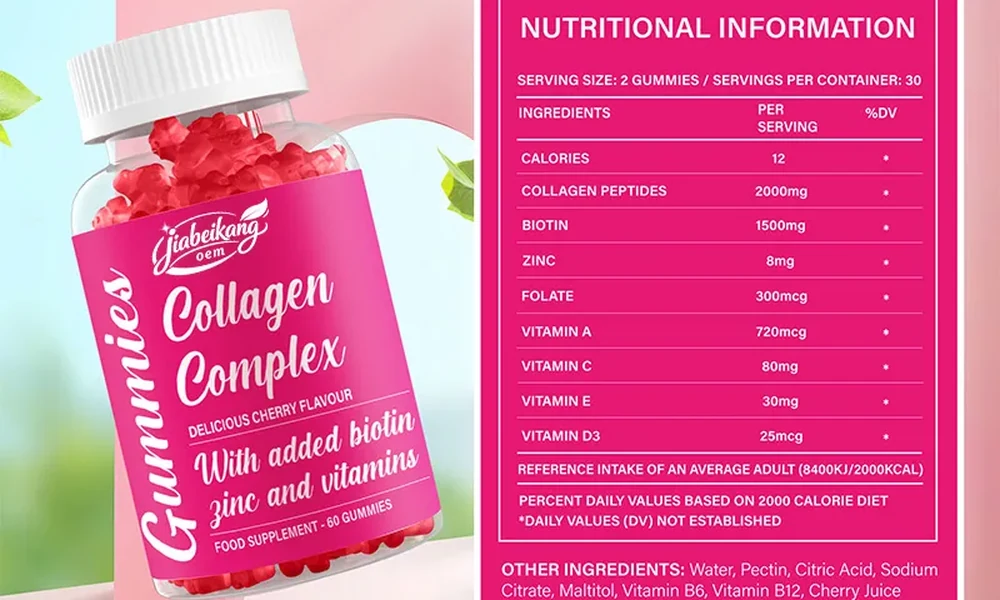
Which prototype checks show whether the payload is workable?
A useful prototype round answers more than “does it taste good?” It should confirm whether the proposed collagen input, gummy count, and package direction can remain connected through the next development stage.
Use an acceptance table with named owners:
| Check | Question for the review team | Possible decision |
| Dose feasibility | Does the selected material fit the planned serving architecture? | Continue, reduce target, or increase gummy count |
| Processing observation | Can the trial be mixed and deposited consistently under the assessed setup? | Continue or revise the formula concept |
| Sensory quality | Are flavor, aroma, chew, and aftertaste acceptable against the brief? | Approve or request a controlled revision |
| Piece and serving fit | Do piece size and count match the intended consumer instruction? | Confirm or redesign the serving |
| Package fit | Does the serving and bottle count support the planned package? | Confirm or change the pack configuration |
| Stability plan | What tests and checkpoints are needed for this formula and package? | Define the project-specific program |
The stability line should remain project-specific. Our guide to gummy supplement testing and stability explains the broader planning questions. It does not justify a fixed shelf-life promise for a new collagen formula. The formula, process, package, and target market need their own evidence.
Keep sample versions traceable. Record the collagen material, input basis, serving count, relevant formula changes, sensory feedback, and approval status. A sample that cannot be linked to its specification is a weak reference for bulk work.
When should a brand reduce the target or change the dosage form?
A brand should reconsider the target when the required raw-material mass forces repeated compromises in chew, flavor, piece size, gummy count, package size, or process consistency. The decision is not a failure of development. It is the point at which product format and commercial promise are brought back into alignment.
There are three practical routes. First, lower the collagen target while protecting the preferred gummy and serving experience. Second, divide the serving across more gummies and check the effect on bottle count and positioning. Third, review whether another dosage form is better suited to the intended payload. Red Kangaroo can assess the gummy route, but the correct choice depends on the brand’s priorities and verified prototype results.
The same discipline applies to combination formulas such as collagen and biotin gummies. Each added active takes formula space and may introduce its own sensory or compatibility questions. The serving architecture must be recalculated rather than inherited from a single-active concept.
A practical collagen payload decision path
Begin with the exact collagen material and a target per serving. Convert that target to raw-material mass, distribute it across the proposed gummy count, and add the rest of the formula requirements. Review the resulting piece size, sensory burden, process observations, and package fit. Then prototype and approve against named criteria.
If the prototype misses an essential criterion, change one of the governing inputs: collagen target, serving count, gummy size, supporting formula, or dosage form. Do not turn an untested marketing target into a production promise.
To request a feasibility review, use our contact page and send the target market, collagen source and specification, intended amount per serving, preferred gummy count, other active ingredients, flavor direction, bottle configuration, and expected order quantity. We will organize the open questions around the formula and prototype rather than offer a universal payload claim.
Need help translating a collagen target into a workable gummy brief? Share the target with the Red Kangaroo team for a feasibility review.