



“Can you make the same gummy without sugar?” sounds like a small revision. In practice, it can be a new development project.
Sugar contributes sweetness, but it also helps build solids, control water, shape the bite, carry flavor, and support the surface of the finished gummy. Remove it and the formula has to recover those jobs through a different sweetener and texture system. The result can be excellent, but it should not be quoted or sampled as a simple subtraction.
For supplement brands, the useful question is not whether sugar-free gummies are possible. It is which sugar-free system fits the product, market, consumer, active ingredients, packaging, and price.
Define what “sugar-free” means for your market
Start with the destination country and the exact front-label wording you hope to use. Nutrition and claim rules differ, and a product that qualifies for one phrase in one market may need different wording elsewhere. Give the manufacturer the target market before it recommends a sweetener system or drafts a specification.
Also separate “sugar-free” from nearby ideas. No added sugar, reduced sugar, low sugar, and sugar-free are not interchangeable. Consumers may read them as the same promise, but formulation and labeling teams cannot. Decide which position is commercially important and ask the label reviewer to confirm it against the complete recipe and finished-product data.
The sweetener choice changes the eating experience
A sugar-free gummy may use polyols, high-intensity sweeteners, soluble fibers, or a combination. Each option has its own sweetness curve, cooling effect, aftertaste, digestive considerations, cost, and processing behavior. There is no universal replacement that behaves exactly like sucrose and glucose syrup.
Some sweeteners arrive quickly on the tongue and disappear quickly. Others linger. Certain systems create a cooling sensation that works with mint or citrus but feels strange in berry, peach, or creamy flavors. Botanicals, minerals, amino acids, and proteins add their own bitterness or dryness, so the sweetener cannot be selected in isolation.
Ask the formulator to explain why a system was chosen, not just what it contains. The answer should connect sweetness, bulk, texture, active load, target consumer, processing, and label position.
Texture is usually the first surprise
A brand may approve the sweetness and still reject the chew. Without a conventional sugar system, a gummy can feel too soft, rubbery, sticky, dry, brittle, or unusually cool. The effect becomes more noticeable when the formula also carries a high dose of active powder.
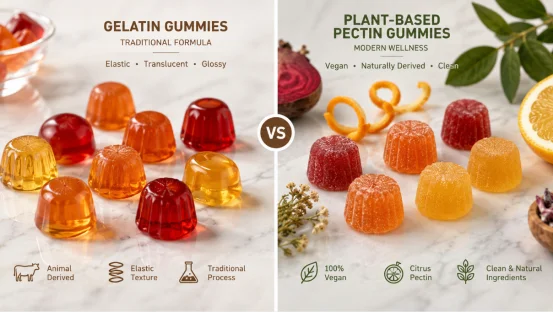
The gelling base matters, but it is only one piece. Pectin supports plant-based positioning and a clean bite; gelatin offers a more elastic chew. Acids, soluble solids, water activity, cooking conditions, depositing temperature, drying time, coating, and storage all influence the final texture. If you are still choosing the base, the site’s gelatin versus pectin guide provides a useful starting comparison.
For sampling, define the texture in ordinary language. “Firm enough not to stick, easy to chew, no hard outer skin, and stable in a warm parcel” is more useful than “premium texture.” Your manufacturer can translate the consumer description into measurable specifications.
Flavor masking needs more than extra aroma
Sugar can soften bitterness and round out acidity. A sugar-free formula exposes difficult notes more clearly, especially with zinc, magnesium, botanical extracts, caffeine, amino acids, or concentrated proteins. Adding more fruit flavor may improve the smell while leaving the finish untouched.
A better sample plan tests the whole flavor structure: sweetness at first bite, acidity during chewing, aroma release, bitterness, dryness, cooling, and aftertaste after swallowing. Two or three controlled variants are usually more informative than a sequence of unrelated flavors. For example, compare two acidity levels with the same berry aroma before changing the sweetener and flavor at the same time.
Keep a small scoring sheet and taste samples under similar conditions. Record what changed in each round. “Sample B has less cooling but a sharper botanical finish” gives the R&D team a direction. “B is better” does not.
Consumer tolerance belongs in the product discussion
Serving size affects more than dosage. Some sugar substitutes or fibers may be less comfortable when consumed in larger amounts, and mandatory statements may apply depending on the ingredient and market. The risk can grow when a daily serving requires several large gummies.
Review the amount per serving, expected daily use, and likely consumer behavior. A product marketed as candy-like may be eaten beyond the suggested serving, particularly if the package is easy to open or the flavor is strong. The label, child-resistant needs, warning language, and package count should be considered together.
Do not make broad digestive claims or assume every consumer will respond the same way. Ask for the ingredient documentation and destination-market review needed for your final formula.
Moisture control can decide whether the launch succeeds
Sugar-free gummies can be sensitive to moisture movement. A sample may look clean on the day it is made, then become tacky, wet, tough, or dull during storage. Coating can help handling, but it cannot rescue a weak moisture and packaging plan.
Ask how the manufacturer controls cooking, drying, conditioning, and room humidity. Confirm the target physical properties for release. Then test the gummy in the intended bottle or pouch, not only in a laboratory container. Closure quality, induction sealing, barrier properties, headspace, desiccant, opening frequency, and transport climate all affect what the customer receives.
If the product will ship through hot or humid regions, include route conditions in the stability conversation. A formula designed for an air-conditioned sample room may not behave the same way in a warehouse, delivery van, or mailbox.
Build a controlled sampling plan
Before the first sample, agree on the variables being tested. One sensible sequence is:
- Confirm target market, claim wording, serving size, and active load.
- Select a base sweetener and gelling approach.
- Screen flavor, acidity, cooling, and bitterness with controlled variants.
- Refine texture, coating, and appearance.
- Place the lead sample in the intended package.
- Review stability, test scope, label copy, and scale-up controls.
Do not approve a sample only because it tastes good when fresh. Keep retained pieces and check them again. Watch for surface moisture, clumping, color shift, aroma loss, crystal formation, hardness, and package interaction.
Price the whole system
Sugar-free positioning can support a premium product, but the cost comparison must include sweeteners, fibers, flavors, process time, testing, yield, coating, packaging, and potential reformulation. A lower ingredient price is not a saving if the formula sticks during packing or needs a more expensive package after artwork is finished.
Ask for a quote that states the gummy weight, count, serving size, package, MOQ assumptions, and included tests. Confirm whether one MOQ covers a single flavor, shape, color, and label version. This keeps supplier comparisons honest.
Where Red Kangaroo fits
Red Kangaroo provides formula, flavor, texture, shape, packaging, and private-label support for gummy supplement projects. Sugar-free options are available across selected concepts, subject to formula feasibility and market review. The development conversation can cover the sweetener system, pectin or gelatin base, active load, sensory targets, packaging, testing, and commercial scale-up in one workflow.
Browse the current gummy product categories for direction, then prepare a brief around your actual consumer and channel. A strong sugar-free product should feel intentional, not like a standard gummy with one ingredient removed.
Часто задаваемые вопросы
Do sugar-free gummies taste different?
They can. Sweetness timing, cooling, acidity, bitterness, and aftertaste depend on the complete sweetener and flavor system.
Are sugar-free gummies automatically low calorie?
Not necessarily. Confirm the finished nutrition data and permitted claim for the target market.
Can a sugar-free gummy also be vegan?
Yes, when the full formula and processing approach support both positions. Pectin is commonly considered, but every ingredient and claim still needs review.
Why do some sugar-free gummies become sticky?
Formula solids, water activity, drying, coating, humidity, and packaging can all contribute. The cause should be investigated as a system.
What should a brand approve before production?
Approve the formula, sensory sample, serving size, specification, testing plan, package, label, and scale-up standard in writing.