



Flavor is often dismissed as a last “room to improve”. Or a choice that developers don’t want to make until the sample is in their hand. And certainly having complete control over flavor is the ideal. But with a supplement gummy, flavor is better thought of as a function within the technical solution.
That may sound like a small detail. It is not. Minerals, amino acids, botanical extracts and other active ingredients can impact flavor, aroma, color and mouthfeel well before a flavor house or formulator has even started to balance the sample. Start with the active ingredient. All raw materials with the same generic designation are not guaranteed to have the same flavor.
Origin, level, vehicle, particle size and processing can alter the flavor profile. One mineral may be metallic and abrasive, another may be prickly bitter, while an extract of a plant may be earthy, astringent and malty or leave a long-lasting aroma. The formulator requires that ingredient as well as intended quantity. It can be misleading to test a generic tryout and you can’t replicate your sample with your commercial raw material.
These are some good questions to ask: Is the ingredient water dispersible or oil soluble? A supplier should be able to explain this choice in plain English. Does it come to life with aroma? Does the flavor release slowly or quickly?
Does the ingredient cause dry mouth or astringency? Will it change color at the anticipated pH in your formula? Does the supplier have a carrier or processing aid? These questions can help qualify the certain sensory tools.
Taste is linked to size of the serving The quality of a bite requires the “desired amount per serving” as requested. If the full serving is broken into four bites, then each bite may contain less of the demanding component than a two-gummy serving. Keep the product brief beside you while you check this. This can yield better flavor and still provide cost and daily portability advantages.
Brand owners need to decide which variable takes precedence: maximum active, bite size, gummy size, lower-sugar goal, mild flavor etc. It may not be possible to get the most of everything in each gummy. Always taste a sensory sample while considering the intended serving size. One gummy may taste more than palatable, while the four-piece bite may become overtaxing or have a lingeringly strong aftereffect.
Sweetness, acidity and aroma all have different functions. Sweetness will give you some bitterness masking, but won’t hide all faults. Acids give a brightness and will enhance fruit character. Would a buyer understand the decision at a glance?
Aroma creates an initial impact and can lead the consumer to a specific, familiar flavor family. They need to work in harmony. Too much acid produces an aggressive, sour flavor and may also interfere with the gelling agent. Too much sweetness will weigh down a product and impact nutrition declaration.
An aggressive aroma can be perceived as artificial, or may drop off during consumption while the rest of the active ingredient remains. it’s not about covering the formula in sugar, it’s about a complete, clean flavor profile from bite to at the end. Some profiles work better against certain challenges. Perhaps citrus works better to work with acidity and some mineral notes.
This is easier to fix before the next sample round. Dark berry profiles can help out botanical formulas that are naturally pigmented. Tropical or spicy notes can help carry aromas that are most difficult to hide without an overly-flavorful veil. that’s not to say that every single ingredient has a one-to-one relationship with a single flavor.
The whole matrix and the target market determine what kind of balancing is required. Consumers of beverages from another country have different expectations of the levels of sweetness and sourness. Instead of “the strongest flavor”, ask for two or three approaches that use different strategies. Comparative sample rounds can reveal whether the customer prefers freshness, sweetness, authenticity or maximum masking.
There should be an aftertaste score too. One side-by-side check can reveal more than a long sales claim. Judges rush to score for first taste and texture, but then forget to look at the product 30 – 60 seconds later: bitterness can develop while chewing, or stay after swallowing; metallic flavours may be most apparent after the fruit aromas have gone; a good scorecard is: aroma on opening; first taste; at the mouth after chewing; grittyness in the mouth; the finish immediately after swallowing; aftertaste for 1 minute; the after-effect on having finished the cup. Have the sample order the same, taste the version in the same order, use plain water between.
Notations are useful rather than ‘good’ or ‘bad’. Texture can exacerbate flavor issues. Grittiness, dryness and over-firmness can amplify a mineral formula’s harshness. A gummy that adheres to the teeth may feel sticky, intensifying lingering bitterness.
A badly dispersed powder may have accumulations of flavor. Since appearance and texture are important to sensory evaluation, you can correct a problem that’s due to particle size, moisture balance or gel structure by changing ingredient source, increasing dispersibility of a line, or changing piece weight, often without the expense of another layer of aroma. If the answer is vague, ask again before signing off. Color reads a consumer’s mind before the first bite.
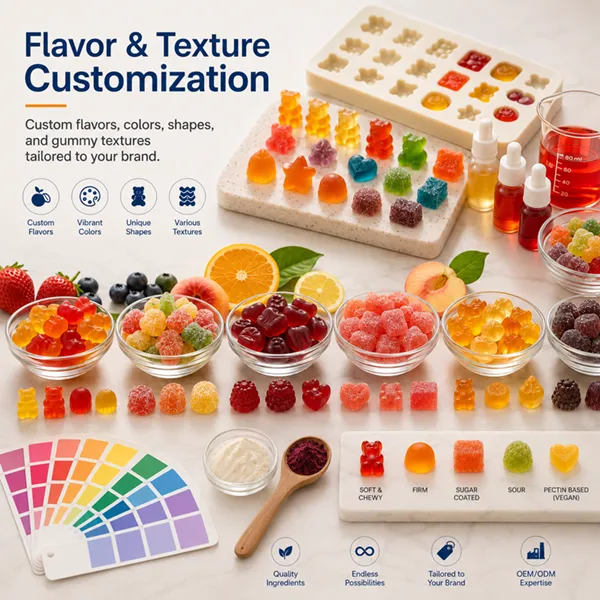
The best bets for consumers reading color to predict taste are those which appear to be one thing, such as a pale yellow of a sunshiny tropical flavor or purple for berry. If the color doesn’t match the flavor profile, the sample may be a little hard to handle, no matter how high quality the formulation. Other active ingredients may also be restrictive, such as the use of a botanical extract that will darken the base, minerals for opacity, or natural coloring that might shift with pH and processing conditions. A customer who insists that a product be colorless or very faint should be told of that priority as early as possible.
Stability of that color also belongs in the stability plan. That attractive color that received sample approval should be tested in the primary package at expected storage conditions. Going sugar free and reducing sugar targets shift the arsenal. This is where a short written note saves time later.
Sugar does more than provide sweetness; it also affects solids, water activity, texture, and overall flavor profile. Its substitution can alter cooling, aftertaste, and digestive tolerance, depending upon the alternative sweetener system used. Never assume the new sugar-free product will taste the same as the sugar-containing control sample; it’s a distinct formulation project. And label verbiage has to fit the target market; marketing verbiage should not be determined before the formulation and nutrition information are settled.
Stability can transform a sampled flavor. Fresh samples can taste different after weeks or months. Volatile aromas can decrease. Oxidation can develop off-notes.
The point is not to add paperwork. It is to avoid a preventable surprise. Moisture migration can alter texture and flavor release in the mouth. Final flavor systems should be tested in the commercial matrix, coating and packaging. A single sample in a laboratory pouch for a period of days doesn’t ensure long-term stability.
Brands and formulators should determine an agreement on stability control points and acceptance levels for appearance, odor, taste, texture and relevant analytical data. “Too many unstructured opinions can hold up a project.” “Bring a small select group that can comment on the ideal consumer and for the product but who use the same scorecard. Involve decision-makers early so the direction approved is not revisited once the projects reach packaging.
Don’t have reviewers pick just one favorite, ask why it was favored, which off-note it’s and if they would eat the entire serving. Here is the practical question: what would you want confirmed before approving the next step? Those answers can be turned into guidance for the formulator.” Can the bitterness be totally eliminated?
Not necessarily. Some formulas can be significantly bettered, but an ingredient load as well as the experience in the mouth after it’s gone can impose some practical limits. What you’re after is what the consumer will find acceptable and repeatable not a zero taste promise. Is the strongest fruit always best?
No. Strength, authenticity, acid control and aftertaste control all count.