



A gummy can feel perfect in a sample jar and still arrive sticky after a hot freight route. Or it may survive shipping, then lose the chew your customers expected. Your gummy base affects texture, dietary claims, production control, packaging, and repeat purchase. So the best gummy base for supplements is the one that fits your buyer promise and your real route to market.
What Should Drive Your Gummy Base Decision?
Start with the product you intend to sell, not a fashionable label claim. Your target shopper, sales channel, climate, active load, and desired bite should shape the brief before you request a quote. That short brief is how to choose a gummy base without letting one claim drive the project.
Start with Your Buyer Promise
Choose gelatin gummies when a soft, elastic, classic chew matters most. Choose pectin gummies when vegan gummies or a plant-based gummy base is central to your position. If your audience checks labels closely, that distinction can influence the click before flavor ever gets a chance.
Match the Base to Your Sales Channel
Retail shelves, direct shipping, and warm export routes place different stress on a gummy. Pectin generally offers better heat stability, while gelatin delivers more bounce. Formula details and packaging still matter. Moisture-proof, light-shielding materials selected through compatibility testing can do more for a long shipment than a prettier jar.
How Do Gelatin and Pectin Compare?
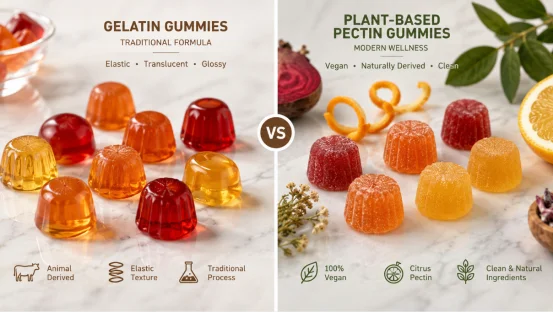
The practical choice in gelatin vs pectin gummies comes down to the eating experience you want and the production controls your formula can tolerate.
| Decision Parameter | Gelatin Base | Pectin Base | Commercial Effect |
|---|---|---|---|
| Source | Animal-derived protein | Plant-derived fiber | Changes vegan and vegetarian eligibility |
| Bite | Elastic, soft, bouncy | Firmer, cleaner break | Shapes customer expectations and reviews |
| Heat Behavior | Softens more readily | Generally more heat-stable | Matters for summer parcels and export routes |
| Formula Control | Heat handling is critical | Acidity and soluble solids need tight control | Affects sample-to-batch consistency |
| Best Fit | Classic, candy-like positioning | Wellness and plant-based positioning | Guides claims, creative, and channel choice |
Choose Gelatin for a Familiar Chew
Gelatin works well when your concept depends on an elastic bite and a familiar gummy feel. It can also suit a formula where plant-based positioning has little value. Ask how the factory controls melting, depositing, drying, and storage temperature. Those steps decide whether the finished piece holds its shape and stays pleasant through shelf life.
Choose Pectin for a Plant-Based Position
Pectin gives you a clearer route to a vegan claim and a firmer bite. It can be a strong choice for wellness-led products and warmer distribution routes. Still, pectin is not a shortcut. Acidity, sweetener system, active ingredients, and cooking conditions all affect the set. A custom gummy formulation should be tested as a complete system, not approved from the base alone.
Which Base Protects Your Launch Economics?
Unit price tells only part of the story. A cheaper gummy that needs reformulation, replacement stock, or rushed packaging changes can cost far more by launch day.
Run a Pilot before You Scale
Ask for samples made on relevant equipment, then test chew, taste, appearance, sticking, and active-content consistency. One sourcing guide notes that some pilot programs start at 5,000 bottles, though every small batch gummy manufacturer sets its own MOQ. Confirm whether the quoted minimum covers one flavor, one color, one shape, and one package format.
Price the Risk, Not Just the Unit
Compare development fees, molds, stability work, laboratory testing, packaging, freight, and rework terms. A useful quote states what happens after a failed sample and whether scale-up needs another approval batch. That detail looks dull on a spreadsheet. It becomes very interesting when stock is due at a retailer.

What Should You Ask a Gummy Supplement Manufacturer?
A capable gummy supplement manufacturer should answer with records, specifications, and samples. Broad promises are not enough when your label and launch budget sit on the line.
Ask for Evidence at the Sample Stage
Request the proposed base, ingredient origin, allergen status, target texture, packaging recommendation, test plan, and Certificate of Analysis. Ask how temperature and humidity are monitored, how each batch is traced, and how the factory checks heavy metals, microbes, and pesticide residues.
For gummy manufacturing, physical-property tests and simulated stability studies deserve a place in the development plan.
Freeze the Specification before the Purchase Order
Approve measurable standards for weight, color, flavor, texture, active content, count, packaging seal, and shelf-life testing. The purchase order should also state MOQ, production schedule, document package, and change-control rules. This makes it easier to compare private label gummies on equal terms instead of choosing the lowest headline price.
Which Production Setup Can Support Both Bases?
Once the base decision is clear, supplier fit becomes easier to judge. Look for separate process knowledge, pilot support, stable scale-up, and export documentation that match your launch plan.
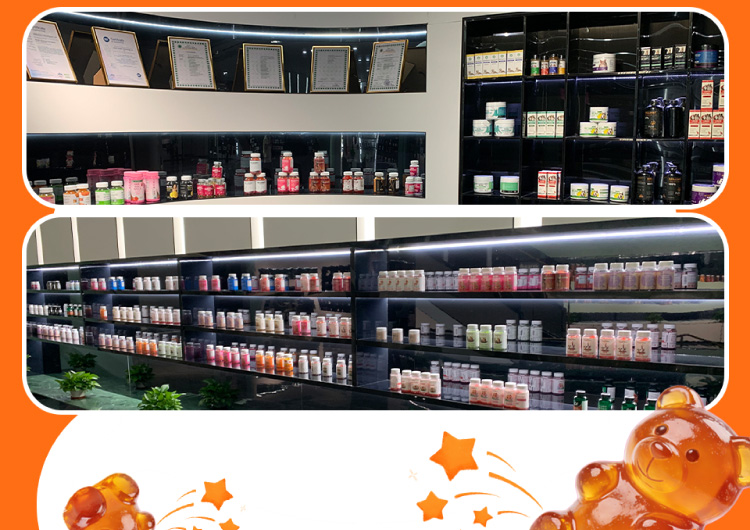
Red Kangaroo supports gelatin, pectin, filled, and liquid-filled gummy formats on flexible lines. Its documented equipment includes 50 L, 100 L, and 300 L gelatin melting tanks, plus controlled cooking, depositing, drying, and coating systems. Samples can be produced in as little as 7 days, while four dedicated gummy lines have a stated daily capacity of 6 million pieces.
The quality program includes incoming batch checks, dual verification during formula weighing, real-time temperature and humidity monitoring, batch traceability, stability work, and third-party testing. For brands comparing a custom gummy formulation, flexible MOQ discussions and support for COAs, laboratory reports, packaging, and export documents can reduce handoffs during launch. Certification coverage includes GMP, HACCP, ISO 22000, Halal, Kosher, and other market-related credentials, subject to project and destination review.
FAQ
Q1: Which gummy base is right for your supplement brand?
A: Pick gelatin for a soft, elastic, classic chew. Pick pectin when plant-based positioning, a firmer bite, or better heat behavior carries more commercial value.
Q2: Are pectin gummies always vegan?
A: Pectin is plant-derived, but the full formula, processing aids, colors, flavors, and shared-line controls must also support the claim. Ask for written ingredient and allergen confirmation.
Q3: Which base works better for hot-weather shipping?
A: Pectin generally handles heat better. Packaging, moisture control, gummy composition, and route testing still affect the result, so approve the product under realistic shipping conditions.
Q4: Does gelatin cost less than pectin?
A: It may at the base level, but your real cost includes development, yield, drying time, testing, packaging, MOQ, and rework risk. Compare landed cost using the same specification.
Q5: How do you choose a gummy base before placing an order?
A: Set your dietary claim, texture target, active ingredients, target market, sales channel, climate, packaging, MOQ, and test plan. Then approve a pilot batch before full production.