



Choosing a supplier is rarely about finding the lowest bottle price. A useful comparison looks at three things together: quality controls, the minimum order for your exact setup, and the time from approval to shipment.
A capable custom gummy partner should show how a product moves from formula review to sample, bulk production, testing, packaging, and delivery. The comparison becomes clearer when every supplier answers the same questions and quotes the same project configuration.
A Practical Comparison of Gummy Manufacturers
Start with evidence, then compare like with like. Ask each supplier for the same formula brief, serving size, packaging format, SKU count, testing scope, and target ship date. This avoids comparing a low MOQ for a stock bottle with a higher MOQ for a fully custom pack.
Use a Supplier Comparison Checklist
| Area | What You Should Compare | Evidence to Ask For |
| Quality | Incoming checks, process control, finished-product release | Certifications, COA, batch records, test reports |
| MOQ | Quantity by SKU, formula, packaging, and tooling | Written MOQ breakdown |
| Lead Time | Sample, material prep, production, testing, shipment | Milestone schedule |
| Capacity | Line availability and scale-up ability | Daily or monthly output data |
| Support | Packaging, labels, export documents | Defined project scope |
This filter also works when comparing a gummy manufacturer for private label with a gummy OEM manufacturer. The buying risks are much the same.
Side-by-Side Comparison: Which Supplier Model Fits?
The fastest way to compare options is to separate the supplier model from the sales promise. A stock private-label supplier may be quick and inexpensive, but usually gives you fewer formula and pack choices. A custom OEM or ODM partner takes more decisions up front, then gives you more control over actives, texture, shape, and labeling.
A large integrated factory may offer the strongest scale and documentation, while a smaller specialist can be easier to work with for a narrow product range. None of these is automatically best. The right choice depends on launch size, differentiation, and the evidence you can verify.
| Supplier model | Usually stronger at | Typical trade-off | Questions to compare |
| Stock private label | Fast launch, simpler packaging | Less formula and shape flexibility | What can change without new tooling? |
| Custom OEM / ODM | Formula, flavor, texture, and pack development | More approvals before bulk production | Who owns the formula and how are revisions priced? |
| Integrated high-capacity factory | Repeat volume, testing, export paperwork | May have higher project minimums | Can the same line support the next three orders? |
What the Comparison Looks Like in Practice
Use the same brief for every quote. Record the formula status, packaging, MOQ per SKU, sample days, bulk days, testing included, and the point at which the schedule becomes fixed.
For a benchmark, Red Kangaroo states that it supports OEM and ODM development, can produce samples in about 5 to 7 business days, publishes a typical bulk cycle of 15 to 25 days after formula confirmation, and operates four dedicated gummy lines with a stated capacity of up to 6 million gummies per day. Treat those figures as supplier-published reference points to verify for your order, not as an industry-wide promise.
Compare Quality by What Happens on the Line
Good quality controls is visible in routine controls. A certificate matters, but it does not tell you how a real batch is handled at 10 a.m. on a busy production day. Ask what happens when raw material arrives, who releases it, what is checked during cooking and depositing, and what records stay with the batch.
Check Controls, Then Compare the Proof
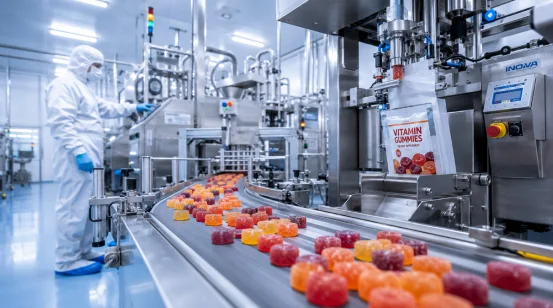
A strong gummy manufacturing quality control system should start before production. The manufacturing process can include supplier qualification and IQC inspection for every incoming batch, with checks for key safety risks. During production, formula weighing may use dual verification, critical control points are recorded, temperature and humidity are monitored, and batch records support traceability.
Ask for gummy manufacturer certifications, but also ask for the process behind them. Finished gummies should be checked before shipment, with packaging, batch coding, and release records tied to the lot. Review the supplier’s gummy product range to see whether its scope matches your planned format.
Ask for Batch-Level Evidence
A gummy supplement manufacturer should be able to discuss COA support, finished-product inspection, third-party testing when needed, stability work, and traceability. Sample-stage laboratory support can also reduce early surprises. One in-house testing workflow covers heavy metals, active-content verification, microbiological analysis, and ingredient identification.
Compare MOQ by Project Configuration
Gummy manufacturer MOQ is not useful as one isolated number. Ask what the number applies to. A formula, printed pouch, bottle, label, new mold, and second SKU can each change the commercial minimum.
Understand What Drives MOQ Changes
Current supplier information lists a general range of about 1,000 to 5,000 bottles, depending on the product and packaging, while manufacturing guidance also treats MOQ as flexible and negotiable. That is why gummy manufacturing MOQ should be confirmed in writing for your exact project.
A low MOQ gummy manufacturer can make sense for a market test, but a low first order may carry a higher unit cost or fewer packaging choices. Compare custom gummy MOQ against expected sell-through, cash tied up in stock, and reorder timing. For multiple SKUs, ask whether each SKU has its own MOQ.
Compare Lead Time by Milestone
A single “three-week lead time” can hide a lot. Gummy manufacturing lead time should be broken into sample development, approval, raw-material preparation, packaging, production, quality release, and shipment. You want to know which stages are fixed and which depend on your decisions.
Separate Sample Time from Bulk Production
The supplier data supports 5 to 7 business days for sample development. Manufacturing records also state that samples can be produced within seven days. For bulk orders, current service information gives a typical 15 to 25 days from formula confirmation to production completion, with larger orders taking longer.
That makes gummy sample lead time different from gummy production lead time. If you change flavor, texture, packaging, or artwork after sample approval, gummy manufacturer lead time may move too. A practical OEM/ODM manufacturing service should show the sequence from requirement confirmation and quotation through sampling, bulk execution, inspection, and delivery.
The gummy manufacturing process also matters here. Drying, coating, packaging, inspection, and release cannot always be compressed just because the launch date is close.
Put the Options on One Scorecard
Price still matters, but the cheapest quote can cost more if it creates rework, stockouts, or delays. Before choosing between gummy manufacturers, score the issues that affect launch and repeat orders.
Use a Simple 100-Point Scorecard
| Category | Suggested Weight |
| Quality and Traceability | 40 |
| MOQ and Launch Flexibility | 25 |
| Lead Time and Capacity | 25 |
| Export and Project Support | 10 |
| Total | 100 |
For capacity, the manufacturing data lists four dedicated gummy lines with output of up to 6 million gummies per day. That matters when you compare gummy production capacity. The real question is not only “Can this factory make my first batch?” but also “Can it make the next three without changing the product or schedule?”

Use a Benchmark Profile Carefully
Once your shortlist is scored, a real supplier profile becomes useful as a benchmark. Red Kangaroo combines formula development, sample production, packaging support, manufacturing, quality testing, and export documentation in one project flow. Its process includes incoming-batch inspection, dual verification for formula weighing, critical control points, environmental monitoring, and batch traceability. Sample development is listed at 5 to 7 business days, while the production setup includes dedicated gummy lines with large-scale daily output. Small-batch trials and flexible order quantities are also part of its manufacturing approach.
For custom gummy manufacturing, that combination matters because fewer handoffs can make MOQ, quality requirements, and schedules easier to compare. If your formula, target quantity, packaging format, testing needs, and launch date are already defined, a project-specific quote request gives you a much cleaner basis for comparison.
FAQ
Q1: What Determines Gummy Manufacturer MOQ?
A: Formula complexity, SKU count, packaging, printed materials, tooling, testing, and order size can all affect MOQ. Ask for a written MOQ tied to your exact configuration.
Q2: How Long Is Gummy Manufacturing Lead Time?
A: It depends on sampling, approval, material preparation, packaging, production, testing, and order size. A typical published bulk cycle is 15 to 25 days after formula confirmation, while sampling can take 5 to 7 business days.
Q3: How Do You Evaluate Gummy Manufacturer Quality?
A: Check incoming inspection, batch records, critical process controls, finished-product testing, traceability, and quality documents. Certificates alone are not enough.
Q4: Should You Choose a Low MOQ Gummy Manufacturer?
A: Choose a low MOQ gummy manufacturer when it fits your launch risk and inventory plan, but compare unit cost, packaging limits, and scale-up terms too.
Q5: How Do You Choose a Private Label Gummy Manufacturer?
A: A private label gummy manufacturer should give you clear specifications, a workable MOQ, documented quality controls, realistic lead times, packaging support, and a path from trial order to repeat production.